題目內容
(請給出正確答案)
題目內容
(請給出正確答案)
[單選題]
Decision on whether the message is right or wrong should at least come after ()what the message is.
A.putting out
B.turning out
C.working out
D.running out
 答案
答案
查看答案
題目內容
(請給出正確答案)
A.putting out
B.turning out
C.working out
D.running out
答案
 更多“Decision on whether the message is right or wrong should at least come after ()what the message is.”相關的問題
第1題
There is no doubt ___the company has made the right decision on the sales project.
A. why
B. that
C. whether
D. when
第2題
According to the passage, jury must be ______.
A.an individual who works in a court
B.a number of people who work under the judge at a trial
C.a dozen people who decide whether someone on trial is guilty or not
D.eleven persons who are in a position to make final decision at a trial
第3題
A. The Websense redirect Web filter solution does not require a license on the SRX device.
B. The Websense server provides the SRX device with a category for the URL and the SRX device then matches the category decides to permit or deny the URL.
C. The Websense server provides the SRX device with a decision as to whether the SRX device permits or denies the URL.
D. When the Websense server does not know the category of the URL, it sends a request back to the SRX device SurfControl server in the cloud.
第4題
1. Emotions play an important role during the negotiation, although their effect is being studied just().
A、at the beginning of negotiation practice
B、during the negotiation process
C、not long before
2. Negative emotions may()make concessions.
A、be helpful to
B、be harmful to
C、be nothing to
3. During negotiations, the decision as to whether or not to settle depends in part on emotional factors.()
A、totally
B、to some extend
C、completely not
4. Attaining concessions can be done()
A、only by negative emotions
B、only by positive emotions
C、by both negative and positive emotions
5. In different cultures, negotiators should use()strategies to show positive and negative emotions.
A、the same
B、different
C、no
第5題
A.畫出一個描述壟斷企業的圖形,包括向右下方傾斜的需求曲線和成本曲線。 Show the profit-maximizing price and quantity. Show the areas that represent profit and consumer surplus at this optimum.
B.Now suppose the firm has previously announced a price slightly above the optimum. Show this price and the quantity sol
D.Show the area representing the lost profit from the excessive pric
E.Show the area representing the lost consumer surplus.
C.The firm decides whether to cut its price by comparing the extra profit from a lower price to the menu cost. In making this decision, what externality is the firm ignoring In what sense is the firm’s price-adjustment decision inefficient
第6題
In the heath-care industry, the doctor-patient relationship is the mirror image of the original relationship between producer and consumer. Once an individual has chosen to see a physician--and even then there may be no real choice it is the physician who usually makes all significant purchasing decision: whether the patient should return "next Wednesday," whether X-rays are needed, whether drugs should be prescribed, etc. It is a rare and sophisticated patient who will challenge such professional decisions or raise in advance questions about price, especially when the ailment is regarded as serious.
This is particularly significant in relation to hospital care. The physician must certify the need for hospitalization, determine what procedures will be performed, and announce when the patient may be discharged. The patient may be consulted about some of these decisions, but in the main 'ii' is the doctor's judgments that are final. Little wonder then that in the eyes of the hospital it is the physician who is the real" consumer".
As a consequence, the medical staff represents the" power center" in hospital policy and decision making, not the administration.
Although usually there are in this situation four identifiable participants, the physician, the hospital, the patient, and the payer (generally an insurance carrier or government) the physician makes the essential decisions for all of them. The hospital becomes an extension of the physician; the payer generally meets most of the bona fide bills generated by the physician/hospital; and for the most part the patient plays a passive role. In routine or minor illness, or just plain worries, the patient's options are, of course, much greater with respect to use and price.
In illness that is of some significance, however, such choices tend to evaporate, and it is for ill ness that the bulk of the health-care dollar is spent. We estimate that about 75-80 percent of health care expenditures are determined by physicians, not patients. For this reason, economy measures directed at patients or the general public is relatively ineffective.
In what aspect is the health-care economy different from other sectors of economy?
A.The relationship between sellers and buyers.
B.The price of the products.
C.The quality of the products.
D.The regulations of health-care industry.
第7題
A. gain tools
B. get an interview
C. make decision
D. become attractive
第8題
(1)What is the main idea of the passage?
A. Values are priorities that tell you how to spend your time.
B. Values help one decline a job promotion.
C. The values list helps one make clear and consistent decisions.
D. Values have limitations when making decisions.
(2)What is NOT TRUE about the benefit of understanding your own values?
A. You can spend more time with your family.
B. You will gain tremendous clarity and focus.
C. It improves the results you get in those truly important areas.
D. You can consult them whenever you need to make a key decision.
(3)Under what circumstance one may need to make a key decision?
A. Where can you have your dinner with your family?
B. When will you have an appointment with a friend?
C. How can you get a seat in a concert?
D. Should you accept the new job you've been offered?
(4)How can you know what is most important to you when making a key decision?
A. By consulting your best friend.
B. By checking the prioritization of values.
C. By finding some useful books in a library.
D. By searching what other people do online.
(5)What is the goal one should keep in mind when making a decision?
A. To get more money.
B. To have more time with family.
C. To fulfill the highest values.
D. To get promoted quickly.
第9題
【C1】
A.advances
B.transforms
C.overturns
D.reflects
第10題
It currently produces and sells 80,000 units per annum, with production of them being restricted by the short supply of labour. Each control panel includes two main components – one key pad and one display screen. At present, Robber Co manufactures both of these components in-house. However, the company is currently considering outsourcing the production of keypads and/or display screens. A newly established company based in Burgistan is keen to secure a place in the market, and has offered to supply the keypads for the equivalent of $4·10 per unit and the display screens for the equivalent of $4·30 per unit. This price has been guaranteed for two years.
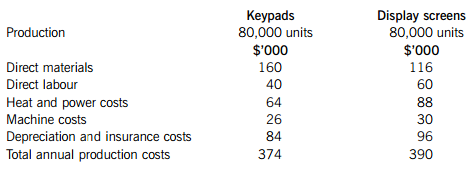
The current total annual costs of producing the keypads and the display screens are:
Notes:
1. Materials costs for keypads are expected to increase by 5% in six months’ time; materials costs for display screens are only expected to increase by 2%, but with immediate effect.
2. Direct labour costs are purely variable and not expected to change over the next year.
3. Heat and power costs include an apportionment of the general factory overhead for heat and power as well as the costs of heat and power directly used for the production of keypads and display screens. The general apportionment included is calculated using 50% of the direct labour cost for each component and would be incurred irrespective of whether the components are manufactured in-house or not.
4. Machine costs are semi-variable; the variable element relates to set up costs, which are based upon the number of batches made. The keypads’ machine has fixed costs of $4,000 per annum and the display screens’ machine has fixed costs of $6,000 per annum. Whilst both components are currently made in batches of 500, this would need to change, with immediate effect, to batches of 400.
5. 60% of depreciation and insurance costs relate to an apportionment of the general factory depreciation and insurance costs; the remaining 40% is specific to the manufacture of keypads and display screens.
Required:
(a) Advise Robber Co whether it should continue to manufacture the keypads and display screens in-house or whether it should outsource their manufacture to the supplier in Burgistan, assuming it continues to adopt a policy to limit manufacture and sales to 80,000 control panels in the coming year. (8 marks)
(b) Robber Co takes 0·5 labour hours to produce a keypad and 0·75 labour hours to produce a display screen. Labour hours are restricted to 100,000 hours and labour is paid at $1 per hour. Robber Co wishes to increase its supply to 100,000 control panels (i.e. 100,000 each of keypads and display screens). Advise Robber Co as to how many units of keypads and display panels they should either manufacture and/or outsource in order to minimise their costs. (7 marks)
(c) Discuss the non-financial factors that Robber Co should consider when making a decision about outsourcing the manufacture of keypads and display screens. (5 marks)